Worldbuilding Entries
Track rules, history, magic systems, and other world details.
Last updated March 2026
Overview
Worldbuilding entries are your story's encyclopedia. They hold the rules, history, and background details that define your world — the kind of information that needs to stay consistent across every chapter and every AI generation. Magic systems, political hierarchies, cultural practices, historical events, technology rules — anything the AI should know and respect when writing your story belongs in a Worldbuilding entry.
Worldbuilding entries feed directly into the Story Bible. When relevant terms appear in your draft, the AI automatically pulls in the corresponding worldbuilding — so your magic system's rules are followed, your history is consistent, and your world feels coherent from the first page to the last.
Creating a Worldbuilding Entry
Create a Worldbuilding entry from the left panel:
- Click the + button at the top of the node tree.
- Select Worldbuilding from the type menu.
- Name it after the topic (e.g., “Tidal Magic System,” “The Great Collapse of 1847,” or “Ironborn Code of Honor”).
Choose a clear, descriptive name. The name appears in the node tree and helps both you and the AI identify what this entry covers.
The Worldbuilding Editor
The Worldbuilding editor opens a rich text editor for writing detailed world content. You get the full formatting toolkit — headings, lists, bold, italic, blockquotes — everything you need to organize complex world information clearly.
The editor includes fields for:
| Field | What It's For |
|---|---|
| Content | The main prose content — world rules, history, explanations. This is the primary body of the worldbuilding entry. |
| Activation Keywords | Words and phrases that trigger this entry's inclusion in AI context when they appear in your drafts. |
| Context Priority | A 1–10 scale that determines how important this entry is relative to others when context space is limited. |
| Notes | Personal notes that are not included in AI context. Use this for reminders, questions, or development ideas. |
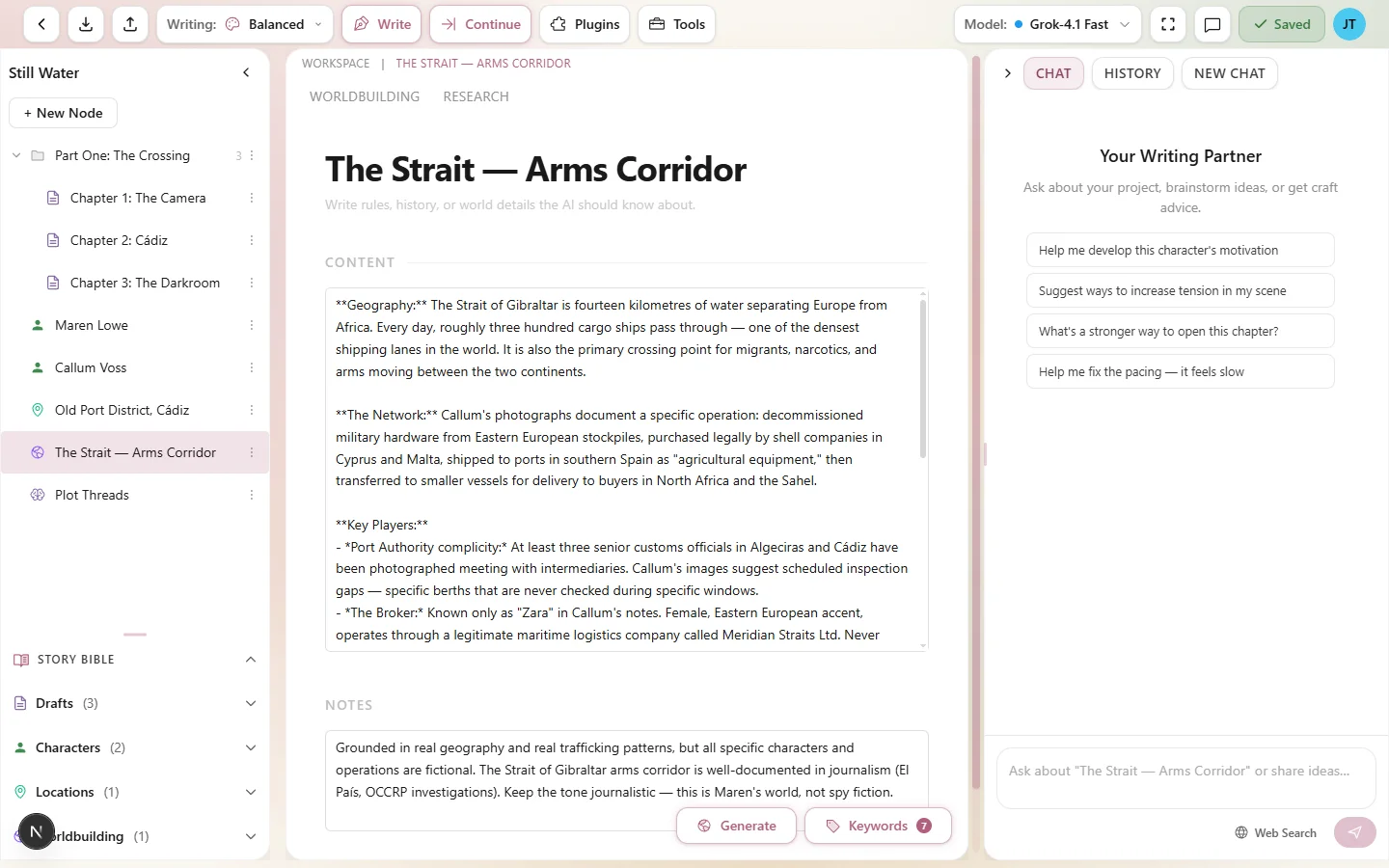
A worldbuilding entry documenting a magic system's rules and limitations
What to Put in Worldbuilding Entries
Worldbuilding entries work best when they cover a single, well-defined topic. Here are the most common types of worldbuilding and what to include in each:
Magic Systems
If your story has magic, the AI needs to know the rules. A magic system worldbuilding entry should cover:
- How it works — what activates it? Is it spoken, gestured, innate?
- What it can do — the capabilities and scope.
- What it costs — energy, materials, physical toll, moral cost.
- What it can't do — limitations and forbidden uses. This is often the most important part for consistent AI output.
- Who can use it — is it universal, hereditary, learned?
Historical Timelines
Key historical events that characters reference or that shaped the world:
- What happened and when.
- Who was involved.
- How it changed the world.
- What people believe about it versus what actually happened (if there's a discrepancy).
Political Structures
How power works in your world:
- Who rules and how they got power.
- Factions, alliances, and rivalries.
- Laws and enforcement.
- How political structures affect daily life for your characters.
Cultural Customs
The practices, beliefs, and social norms that make your world feel lived-in:
- Greetings, social hierarchies, taboos.
- Celebrations, rituals, rites of passage.
- Food, clothing, art, language quirks.
- Attitudes toward outsiders, technology, or the supernatural.
Technology & Science
Especially important for science fiction, but relevant to any story with technology that differs from the real world:
- What technology exists and how it works (at a story-relevant level of detail).
- What technology does not exist (important for consistency).
- How technology affects society and daily life.
- Rules and limitations of key technologies.
Religions & Belief Systems
Spiritual and philosophical frameworks in your world:
- Core beliefs and practices.
- How religion interacts with political power.
- Tensions between different belief systems.
- How belief shapes character motivations and moral decisions.
Worldbuilding & the Story Bible
Worldbuilding entries are a core part of the Story Bible — the system that feeds world information to the AI during prose generation. Here's how the connection works:
Activation Keywords
Every worldbuilding entry can have activation keywords — words or phrases that, when they appear in your draft text, trigger the Story Bible to include that entry's content in the AI's context.
For a worldbuilding entry about a magic system called “Tidal Magic,” your activation keywords might include “tidal magic,” “the tides,” “casting,” and “spellwork.” When any of these terms appear in the draft you're writing, the AI automatically gets the magic system's rules and limitations.
Context Priority
The AI has limited context space. When multiple worldbuilding entries match, the system uses context priority (1–10) to decide which ones to include first. Higher priority entries take precedence.
Set high priority (7–10) for foundational world rules that should always be respected — magic system limitations, essential historical facts, core cultural taboos. Leave supporting detail entries at the default (5) or lower.
Automatic Story Bible Matching
The Story Bible matching is automatic. You don't need to manually specify which worldbuilding applies to which draft. As long as your activation keywords are set, the system handles the matching:
- You write (or the AI generates) prose that mentions “tidal magic.”
- The Story Bible matcher detects the keyword.
- The Tidal Magic worldbuilding entry's content is included in the next generation's context.
- The AI writes the scene following the magic system's established rules.
This is why worldbuilding entries are so powerful for consistency. Once you define the rules, the AI follows them automatically in every scene where they're relevant.
One Topic per Entry
The single most important rule for effective worldbuilding entries: keep each entry focused on one topic.
A worldbuilding entry that covers your magic system, your political structure, and your religious customs all in one giant document is harder for the AI to use effectively. The context builder includes entire worldbuilding entries, not excerpts — so a focused entry means the AI gets exactly the relevant information without wasting context space on unrelated details.
Instead of one massive “World Guide” entry, create separate entries:
- “Tidal Magic System” — rules, costs, limitations.
- “The Council of Salt” — political structure and power dynamics.
- “Tidecaller Traditions” — cultural customs of magic users.
- “The Great Drowning” — historical event that shaped the world.
Each entry has its own activation keywords, so only the relevant worldbuilding is pulled into context for any given scene. This is more efficient and produces better AI output.
Worldbuilding vs. Locations
Worldbuilding entries and Location nodes are complementary but serve different purposes:
| Worldbuilding Entries | Location Nodes |
|---|---|
| Abstract rules and systems | Specific physical places |
| History, culture, religion, politics | Settings, atmosphere, sensory details |
| “How magic works in this world” | “What the wizard's tower looks like” |
| Freeform prose content | Structured fields (type, atmosphere, details) |
Use worldbuilding for the rules of your world and locations for the places in it. They work together — a location might reference worldbuilding (the tower follows the rules of tidal magic), and worldbuilding might reference locations (the Council meets in the Salt Hall).
Genre Considerations
Worldbuilding entries are especially valuable for certain genres:
- Fantasy — magic systems, races, mythologies, ancient prophecies, feudal structures. Fantasy worlds need the most worldbuilding to stay consistent.
- Science Fiction — technology rules, alien cultures, physics of FTL travel, corporate hierarchies, AI rights. Hard sci-fi needs especially detailed worldbuilding for the AI to respect the science.
- Historical Fiction — period-specific customs, social norms, technology limitations, real historical events that intersect with your story.
- Mystery & Thriller — organizations, procedures (police, legal, intelligence), technology capabilities, institutional hierarchies.
- Contemporary Fiction — even realistic settings benefit from worldbuilding entries for workplace culture, family dynamics, local customs, or subcultures that the AI might not know about.
Every genre benefits from worldbuilding — the question is how much. A contemporary romance might only need a few entries about the small town where it's set. An epic fantasy might need dozens.
Tips for Writing Worldbuilding Entries
- Write for the AI, not an encyclopedia. Worldbuilding entries don't need to be exhaustive worldbuilding documents. They need to contain the information the AI requires to write consistent prose. Focus on rules, limitations, and details that directly affect how characters behave and how scenes play out.
- Emphasize constraints and limitations. The AI is creative by default. What it needs most from worldbuilding is what not to do. “Magic cannot raise the dead” is more useful than “magic can create fire.”
- Include character connections. Worldbuilding becomes more powerful when it references your characters. “Elena is the last living Tidecaller” bridges your worldbuilding to your character data and helps the AI write Elena consistently.
- Update as the story evolves. World details change as you write. If a war ends or a government falls, update the worldbuilding entry. The AI always uses the current version.
- Use the notes field for yourself. The notes field is not sent to the AI. Use it for development ideas, open questions, or reminders about things you haven't decided yet.
- Set activation keywords generously. It's better to have a worldbuilding entry activate too often than too rarely. The AI having extra context is less harmful than missing context it needs for consistency.